Thermal runaway propagation remains one of the most challenging scenarios in lithium-ion battery systems. While automotive-grade batteries are highly reliable and unlikely to initiate failure, events can become difficult to control once propagation begins.
Did you know? Traditional mitigation methods, such as thermal barriers or compartment-level suppression systems, often struggle to effectively reach the source of the event.
Our way of working. Volvo Energy’s approach focuses instead on direct liquid injection inside the battery pack structure itself. By enabling the suppressants to access and cool cells directly, the system can stop propagation more effectively while reducing the need for large volumes of suppression agents.
Volvo Energy tested a PFAS-free direct injection solution with high thermal capacity and non-conductive properties. Test results demonstrated that the solution could successfully control thermal runaway propagation without major modifications to automotive battery packs.
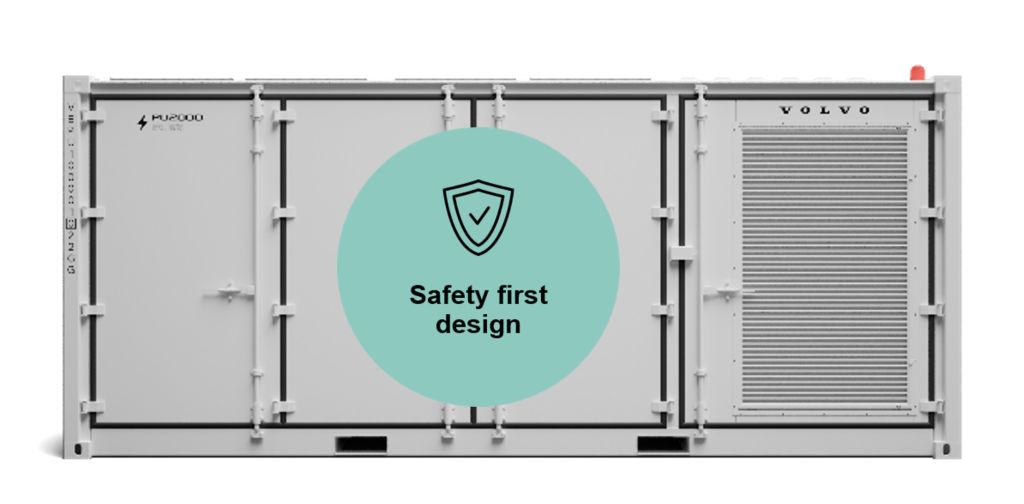
Our solution. The technology is now integrated into the Volvo PU2000, Volvo Energy’s high-performance 2 MWh stationary energy storage system. Designed with a “safety first” philosophy, the PU2000 combines advanced fire suppression, cybersecurity, monitoring capabilities, and turnkey integration to support customers in the transition toward fossil-free energy solutions.
“As energy storage deployment accelerates worldwide, energy storage needs advanced fire suppression, and therefore, safety must be engineered into every layer of the system. Through advanced direct injection technology, Volvo Energy is helping set a new benchmark for safe, reliable, and scalable energy storage.“ Mark Ellis, Head of Battery Technology at Volvo Energy, concludes.