The role of Battery Energy Storage Systems in scaling electric commercial vehicles and machines
2026-05-28
Niklas Thulin, Head of BESS products Volvo Energy
The electrification of commercial vehicles and machinery is a key component in the decarbonization and evolution of the transport and industrial sectors. With widespread availability, declining costs, rapidly improving infrastructure and clear economic benefits, adoption is expected to accelerate over the coming decade. However, practical and operational challenges still need to be addressed.
From the perspective of fleet operators, two commonly raised concerns are congested grids and availability of public charging infrastructure. This is even though the current market share of new electric truck and bus sales remains low, standing at 2.3% and 18.5% respectively in the EU. [ACEA, ‘Economic and Market Report Global and EU auto industry: Full year 2024’, 2025].
To increase the market share significantly in the coming decades, even more affordable, reliable and quick-to-deploy solutions for charging will be required. This is where Battery Energy Storage Systems (BESS) can play an important role, both by enabling charging and silent zero emission power in more temporary settings (e.g. at construction sites or during events), and by optimizing the operation of more permanent charging installations (e.g. public fast-charging sites, logistics hubs, vehicle dealerships, workshops or depots).
Overcoming grid constraints in limited-grid or off-grid applications
A mobile BESS used in island mode (i.e. without a permanent grid connection) can in many cases replace traditional diesel or gas generators in temporary, off-grid applications. Compared with conventional generators, the BESS offer higher energy efficiency, zero emissions during operation, and a significant reduction in noise levels at the site. In addition, rapid power response of the BESS and few moving parts contribute to improved reliability and productivity.
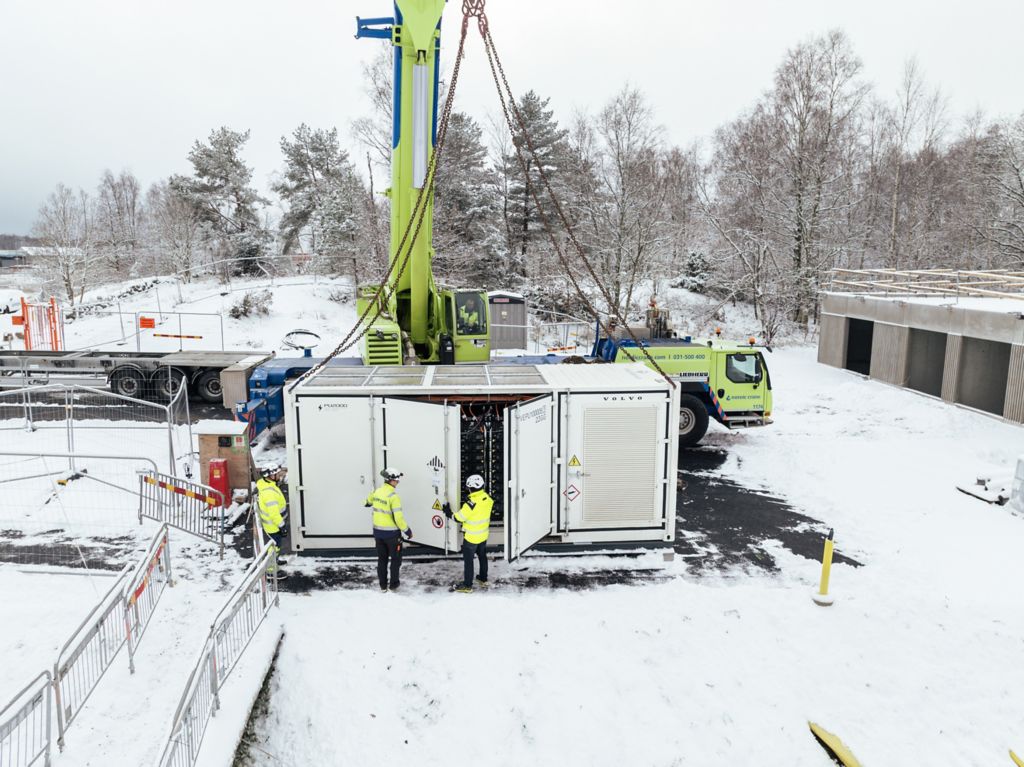
The PU500, a mobile BESS with integrated high power DC charger, enables charging in more temporary settings.
In a commercial vehicle and construction equipment context this type of product, especially those with integrated chargers, is an important enabler for the operation of electric vehicles and machines. Common applications include construction sites, larger events, music festivals and vehicle sales or demonstration activities.
Optimizing charging operations
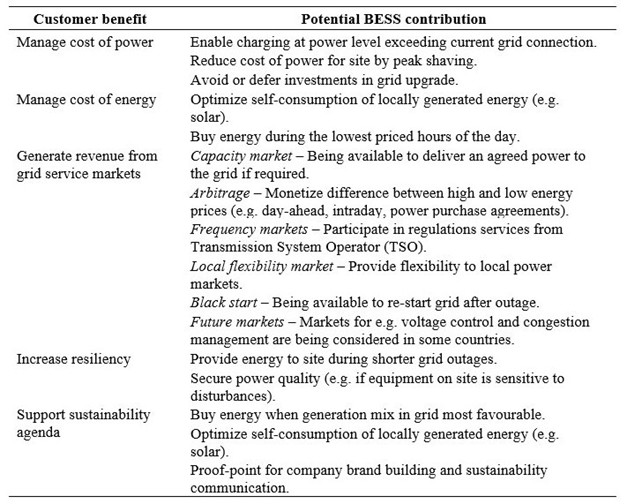
In addition to mitigating grid constraints at site, a BESS can support the operation of charging infrastructure in several ways, see table 1 below.
Table 1: Potential BESS contributions in optimizing the operation of charging infrastructure
The business case for integrating a BESS at a charge site in most cases relies on the successful stacking of several of the services highlighted, which puts high requirements on the BESS and the site Energy Management System (often called EMS). AI and machine learning plays a significant role in current EMS development by enhancing predictive analysis capabilities (e.g. maintenance, power demands, market prices and weather forecasting), fault detection, and cost and revenue optimization.
Conclusion
Together, these factors position BESS as a key enabler for scaling electric commercial vehicles and machines, both by overcoming grid constraints and by strengthening the business case for electrification. In combination with new business models and financial solutions, I am confident BESS can accelerate investments, reduced risk for operators, and support a faster ramp-up of electric trucks, buses and machines.
During 2025, Volvo Energy launched solutions for both temporary and permanent charging applications. The Volvo PU500 is a mobile solution designed for providing temporary power and charging support, with use cases such as construction sites, events, and vehicle demonstrations. The Volvo PU2000 is a high-performance energy storage solution supporting commercial and industrial sites, and EV charging needs, where it supports cost optimization and operational flexibility.
To learn more about these solutions and how they can contribute to your business, please feel free to contact me or use the contact form.